
Why llms.txt Isn't Working, and How to Fix It
There's a reasonable idea behind llms.txt. Proposed by Jeremy Howard in September 2024, it follows the same logic as robots.txt: place a structured file at your root, and AI systems can find a curated, structured description of your site, without needing to crawl every page to piece together what you do.
The proposal is sensible. The execution, for most sites, is broken in two specific ways that are easy to miss and straightforward to fix.
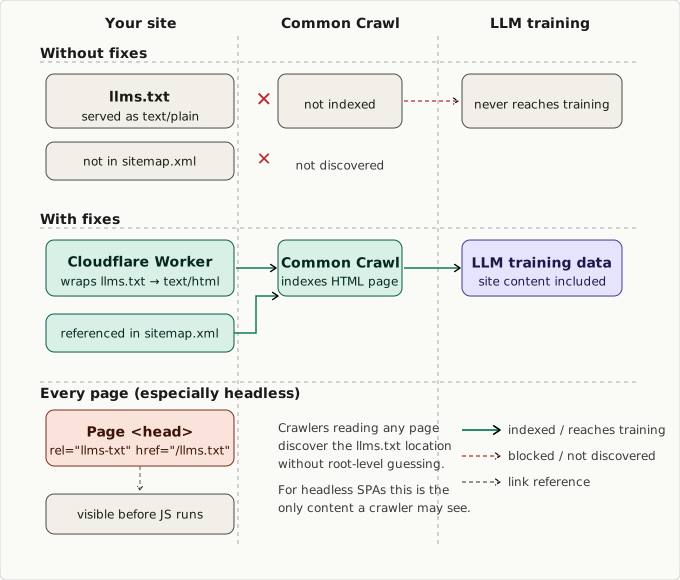
llms.txt reaches LLM training data, serve as text/html and reference it in sitemap.xml.The Two Problems Nobody Mentions
A common assumption is that llms.txt is useful at inference time, that is, when an AI agent is actively retrieving information to answer a query. That's largely not the case. Agents operating at inference time follow their own retrieval logic; they aren't scanning your root directory for an llms.txt file on each request.
Where llms.txt does have genuine value is in training data. A richer, curated description of your site's content and structure is more useful to a training pipeline than a bare sitemap, it can provide context, intent, and relationships between pages that a crawler would otherwise have to infer. But that value only materialises if the file actually gets into training data, and this is where most implementations fail.
Problem one, it is not served as HTML
Common Crawl, which underpins the training datasets of most large language models, indexes HTML pages. Your web server will serve llms.txt with a Content-Type: text/plain header by default. Common Crawl won't treat that as an HTML page, and it won't be indexed as one.
The fix is to wrap the content in a minimal HTML document and serve it with Content-Type: text/html. On Cloudflare, a Worker handles this cleanly for the one URL that needs it:
export default {
  async fetch(request) {
    const url = new URL(request.url);
    if (url.pathname === '/llms.txt') {
      const content = await fetch('https://your-origin.com/llms.txt')
        .then(r => r.text());

      const html = `<!DOCTYPE html>
<html lang="en">
<head>
  <meta charset="UTF-8">
  <title>llms.txt</title>
</head>
<body>
<pre>${content}</pre>
</body>
</html>`;

      return new Response(html, {
        headers: { 'Content-Type': 'text/html; charset=utf-8' }
      });
    }
    return fetch(request);
  }
};
To make the difference concrete, here is a real llms.txt, the one we use for allabout.network, as it sits on the server before any wrapping:
# allabout.network, CogNovaMX

> Making the web, and everything you publish beyond it, work for everyone and everything that uses it.
> MX (Machine Experience) is structured metadata that makes your content
> readable by every AI agent on earth, without making it less readable by humans.

## About CogNovaMX

- Company: https://mx.allabout.network/
- Author: https://www.linkedin.com/in/tom-cranstoun/
- Contact: mailto:info@cognovamx.com
- Website: https://allabout.network

CogNovaMX works on Machine Experience (MX) methodology. Founded by Tom Cranstoun -
content management specialist since 2001, conference speaker, and author of the MX book
series. We help organizations design websites that work for both humans and machines.

## Services

- MX Readiness Assessment: Structured audit against MX principles, structured data,
  accessibility, agent interaction testing, competitive benchmarking
- Implementation Support: Schema.org implementation, accessibility fixes, explicit intent
  patterns, code reviews, knowledge transfer
- Team Training: Fundamentals workshops, technical deep-dives, role-specific training for
  developers, designers, content authors, QA, and leadership
- Strategic Advisory: Monthly strategy sessions, architecture reviews, competitive
  intelligence, quarterly roadmap planning

## Docs
- [MX Books](https://mx.allabout.network/books/): The MX book series.
- [MX Community](https://tg.community/): The Gathering, open MX standards body.

## Optional
- [Blog](https://allabout.network/blogs/ddt/): Articles on MX, CMS, and AI readiness.
This is what an LLM training pipeline needs to understand who we are, what we do, and where to find more. It describes services in plain terms, links to substantive content, and gives enough context that an AI system encountering it during training can form an accurate picture of what we do, without needing to crawl dozens of pages. That's the point of the format: curated signal, not bulk content.
And here is the same content after HTML wrapping, as Common Crawl will see it:
<!DOCTYPE html>
<html lang="en">
<head>
<meta charset="UTF-8">
<title>llms.txt, allabout.network</title>
</head>
<body>
<pre>
# allabout.network, CogNovaMX
> Making the web, and everything you publish beyond it, work for everyone and everything that uses it.
> MX (Machine Experience) is structured metadata that makes your content
> readable by every AI agent on earth.
## About CogNovaMX
…
</pre>
</body>
</html>
The content is identical. The wrapper is minimal. The difference is that crawlers will now index it.
What this site actually deploys
The snippet above is the minimum viable version, enough to make Common Crawl treat your llms.txt as HTML. The Worker that runs in front of allabout.network, mx.allabout.network, content.allabout.network and reginald.allabout.network goes a few steps further, because if we're going to wrap the file in HTML at all, we may as well make it carry the metadata that crawlers and AI agents already know how to read.
Here is the actual pure helper running on this domain. You can verify it for yourself: visit https://mx.allabout.network/llms.txt in a browser, use View Source, and compare it to the function below.
// Wrap raw llms.txt content as a minimal HTML document so Common Crawl
// (which only ingests HTML) can index the content. Preserves the original
// text verbatim inside <pre>; no transformation of the text body.
//
// Pure function, testable in Node without the Workers runtime.
export const wrapLlmsTxtAsHtml = (text, requestUrl) => {
const safe = (text || '')
.replace(/&/g, '&')
.replace(/</g, '<')
.replace(/>/g, '>');
// Title: first "# heading" line if present, else hostname-based fallback
const firstHeading = (text || '').split('\n').find((l) => l.startsWith('# '));
let host = '';
let canonical = '';
try {
const u = new URL(requestUrl);
host = u.hostname;
// Strip query string and fragment, canonical should be the bare resource URL
u.search = '';
u.hash = '';
canonical = u.toString();
} catch (_) {
// requestUrl is optional, tests may call without one
}
const title = firstHeading
? firstHeading.replace(/^#\s+/, '').trim()
: `llms.txt${host ? `, ${host}` : ''}`;
const jsonLdObj = {
'@context': 'https://schema.org',
'@type': 'WebPage',
name: title,
description: 'Agent directory file (llms.txt) served as HTML for crawler ingestion.',
inLanguage: 'en-GB',
};
if (canonical) jsonLdObj.url = canonical;
const jsonLd = JSON.stringify(jsonLdObj);
const canonicalTag = canonical ? `<link rel="canonical" href="${canonical}">\n` : '';
const descHost = host || 'this site';
return `<!DOCTYPE html>
<html lang="en-GB">
<head>
<meta charset="utf-8">
<meta name="viewport" content="width=device-width, initial-scale=1">
<title>${title}</title>
<meta name="description" content="Agent directory file for ${descHost}, published as HTML so AI training crawlers can ingest it.">
<meta name="robots" content="index, follow">
<meta name="mx:status" content="active">
<meta name="mx:contentType" content="agent-directory">
<meta name="mx:audience" content="machines, humans">
${canonicalTag}<script type="application/ld+json">${jsonLd}</script>
<style>body{font:14px/1.5 ui-monospace,Menlo,Consolas,monospace;max-width:80ch;margin:2rem auto;padding:0 1rem;color:#1a1a1a}pre.llms-txt{white-space:pre-wrap;word-wrap:break-word}</style>
</head>
<body>
<main>
<pre class="llms-txt">${safe}</pre>
</main>
</body>
</html>`;
};
The differences from the minimum viable snippet are deliberate, and each one earns its place:
- HTML escaping: the raw
llms.txtmay legitimately contain<,>, or&. Inserting that into a template without escaping would corrupt the document and, in the worst case, smuggle markup into the page. The minimum-viable snippet skips this for clarity; production can't. - Title from the first
#heading: most well-formedllms.txtfiles start with a heading like# allabout.network, CogNovaMX. Promoting it to<title>gives crawlers and humans a real page title for free, with a sensiblellms.txt, {hostname}fallback if there's no heading. <link rel="canonical">: tells crawlers that the bare.txtURL is the canonical address for this content, so the HTML wrapping is treated as a presentation of the same resource rather than a separate page that competes with itself. Query strings and fragments are stripped so cache-busters don't pollute the canonical.<meta name="robots" content="index, follow">: explicit indexing permission. The point of the exercise is to be indexed, so we say so.- MX governance metadata: three carrier tags (
mx:status,mx:contentType=agent-directory,mx:audience=machines, humans) tell MX-aware tooling that this is a live agent directory intended for both audiences, not a general-purpose page. This is the same pattern every other MX page on the site uses. - Schema.org JSON-LD: a small
WebPageblock. Schema.org is the structured-data vocabulary every major training pipeline already understands. Adding it costs nothing and gives the wrapped file a structured identity. - Inline minimal CSS: readable in browsers without depending on any external stylesheet. The wrapped
llms.txtstays self-contained even if the rest of the site is unreachable. - Pure-function shape: the helper takes a string and a URL, returns a string. No
HTMLRewriter, no Workers-runtime APIs in the body. This means it can be unit-tested in Node without spinning up a Worker, and on this codebase it is, with thirteen tests covering the title extraction, canonical stripping, escaping, fallbacks, and verbatim preservation.
The Worker calls this function from two places, once in the path that handles mx.allabout.network / content.allabout.network / reginald.allabout.network, and once in the path that handles allabout.network itself. Both call sites use a basename match (filename === 'llms.txt' or endsWith('/llms.txt')), so the wrapping fires automatically for any llms.txt at any depth, root /llms.txt, /blog/llms.txt, /services/llms.txt, anywhere. None of the source .txt files are modified. The HTML view exists only at serve time.
Problem two, it is not in sitemap.xml
If your llms.txt isn't referenced in your sitemap, crawlers have no reliable signal that it exists. It won't be systematically discovered, which means it won't make it into Common Crawl, and therefore not into LLM training.
Fix both of those things, serve llms.txt as an HTML page, and include it in your sitemap, and it has a reasonable chance of being included. These aren't technical challenges. They're configuration decisions that most teams simply don't make, because the guidance around llms.txt rarely addresses training pipelines.
What MX Practice Says About This
MX, Machine Experience, is a discipline concerned with how digital content is read, interpreted, and used by machines: AI agents, search indexers, voice assistants, training pipelines, and browser automation. Where web accessibility asks how we make content usable for people with disabilities, MX asks the same question about non-human readers. The two turn out to share most of the same answers. You can read more in the MX book series.
From an MX perspective, the llms.txt situation is a familiar pattern. The principle that guides MX work is straightforward: if you want machines to read your content reliably, you can't depend on them inferring what you intended. You have to make the structure explicit, using mechanisms that machine readers already understand.
llms.txt in its current common form asks AI systems to discover and interpret a relatively new standard. But most AI systems being trained right now have knowledge cutoffs that predate the proposal entirely. The standard is invisible to the very systems it's designed to inform.
This isn't an argument against llms.txt. It's an argument for implementing it in a way that works with existing infrastructure rather than waiting for new systems to catch up. That's actually one of the core principles of MX: don't reinvent, reuse existing patterns. Crawlers already understand HTML. Sitemaps already signal what matters. Use what is already there.
The HTML meta tag approach does exactly that. Rather than relying on a crawler to find and correctly handle a markdown file, you embed the key information in the HTML that crawlers already process, on every page that matters. Add a link tag pointing to your llms.txt, alongside a meta description, in the <head> of every page:
<link rel="llms-txt" href="/llms.txt">
<meta name="llms-txt-description" content="A description of your site and its content.">
The link tag tells any agent or crawler that encounters the page exactly where to find the llms.txt file, no guessing, no root discovery required. For sites where the text is concise enough, the full content can also go directly into the page as a meta tag:
<meta name="llms-txt-content" content="# Your Site > Description...">
No new standard needs to be adopted. No new assumptions about how crawlers work need to be made. The structural information is present in the HTML itself, where crawlers have always looked.
A Note on Headless and JavaScript-Rendered Sites
If the above matters for conventional sites, it matters more for headless and JavaScript-rendered ones, and this is where llms.txt, done correctly, becomes particularly useful.
Headless CMSs, Contentful, Sanity, Hygraph, and similar, deliver content through APIs to a frontend that renders it in JavaScript. When an AI scraper visits the resulting site, it typically sees something like this:
<body>
  <noscript>You need to enable JavaScript to run this app.</noscript>
  <div id="root"></div>
</body>
No content. Just a shell. The scraper can't see the products, articles, or services the site exists to describe. The link tag and meta description approach is especially useful here because they sit in the <head>, the section of the page that is served before JavaScript runs, and the only section most crawlers will ever see. You're not waiting for the JavaScript to execute; the reference to llms.txt is already in the response.
The Standard Behind the Recipe
The three moves above, serve as HTML, list in sitemap.xml, link from every page, aren't just a recipe for llms.txt. They're a generic discoverability discipline that applies to any agent-directory file a host might publish: llms.txt today, ai.txt or whatever comes next tomorrow, even robots.txt if you want it to reach training pipelines rather than only crawlers that already know to look for it. The same three failure modes apply to all of them, and the same three fixes work in all cases.
That generality is now formalized. The MX Agent Directory Discovery note is a draft standard offered to The Gathering for community review. It specifies three conformance levels for any agent-directory file:
- Level 1 Transport: the file MUST be served as
text/htmlat its canonical URL. The wrapper must preserve the directory text verbatim, escape HTML metacharacters, set<link rel="canonical">to the bare resource URL, and carry an explicit<meta name="robots" content="index, follow">. - Level 2 Discovery: if the host publishes a
sitemap.xml, the agent-directory file MUST be listed in it. Hosts without a sitemap aren't in scope for this level; they should still reach Level 1 and Level 3. - Level 3 Resilience: every page on the host SHOULD include a
<link rel="directory-name" href="/file">in its<head>, where the rel value is the bare directory name (sorel="llms-txt"for/llms.txt,rel="ai-txt"for/ai.txt, and so on). This is what keeps the file discoverable when the body is empty until JavaScript runs.
The note refers only to actually-published external standards, RFC 2119 and 8174 for normative language, RFC 9110 for HTTP semantics, the Sitemaps 0.9 protocol, the HTML Living Standard, and Schema.org for the optional JSON-LD block. It deliberately doesn't redefine llms.txt or any other directory format, those remain owned by their own communities. What it specifies is the transport, discovery, and resilience layer that any agent-directory file SHOULD adopt to be reliably reached.
If you implement the recipe in this post, you can claim Level 3 conformance to the draft. If your team is comparing two implementations or specifying procurement requirements, the conformance levels give you a vocabulary that doesn't depend on any particular blog post or worker snippet.
The Checklist
If you're implementing llms.txt, for any kind of site, the steps map directly onto the three conformance levels in the draft:
- Level 1. Serve the file as
text/html, use a Cloudflare Worker (or equivalent edge function) to wrap the content and set the correct header. - Level 2. Add it to
sitemap.xml. - Level 3. Add
<link rel="llms-txt" href="/llms.txt">to the<head>of every page, especially important for headless sites where the page body may be empty until JavaScript runs.
Verification at each level is a single shell command. Level 1 is a curl -I against the directory URL checking the Content-Type header. Level 2 is a grep against sitemap.xml. Level 3 is a grep against the rendered <head> of any sample page.
Readable by Both Means Readable by Both
MX doesn't treat machine readability as a separate track from how humans read. The same content, properly structured, should work for both. llms.txt is consistent with that principle, but only when it's implemented in a way that puts it in front of the systems that matter.
Right now, most llms.txt files are well-intentioned but structurally invisible. They aren't in sitemaps. They aren't served as HTML. They won't appear in Common Crawl. They won't reach LLM training data.
The fix is straightforward. But it does require understanding what llms.txt is actually for, and that starts with being honest about where it currently falls short.
Related reading
- MX Agent Directory Discovery note (draft v1.0), the formal standard the recipe in this post claims conformance against
- Agent Discoverability: What Your Site Is Missing, diagnose the signals AI agents look for
- What Is Machine Experience?, the discipline behind these patterns
- Machine Experience: Adding Metadata, the 5-stage agent process
- MX: A New Role, audit data and the convergence principle